Appnext

Jumat, 01 Juli 2016

Roger Penske receives Argetsinger Award from Watkins Glen Research Center


The International Motor Racing Research Center presents the 2016 Cameron R. Argetsinger Award for Outstanding Contributions to Motorsports to Roger Penske on June 30, 2016, at the Corning (N.Y.) Museum of Glass. From the left are Duke and J.C. Argetsinger, sons of Cameron Argetsinger, Penske and Bobby Rahal, Indianapolis 500 champion and chairman of the IMRRC Governing Council. (photo by Angelo Lisuzzo; provided by the IMRRC.)

Corning, N.Y. --


Team owner, racer, and businessman, Roger Penske, a man who has been involved with motor sports for over 50 years, received the 2016 Cameron R. Argetsinger Award from the International Motor Racing Research Center (IMRRC) at a banquet in his honor Thursday evening, June 30, 2016. The event that brought motor sport royalty from several areas of the sport to pay tribute to Penske was held at the Corning Museum of Glass (CMOG) in Corning, NY, about 20 miles south of Watkins Glen.  Previous recipients of the award have been Chip Ganassi in 2014 and Richard Petty in 2015.


Following a cocktail reception outside, the capacity audience in the museum banquet facility saw a video explaining the work and mission of the IMRRC. The research library contains over 700 collections and more than 90,000 professional photographs of motor sport, along with many other items.

Just announced that evening the IMRRC was pleased to let the audience know that it will now manage all 73 years' worth of archives for the 68,000-member strong Sports Car Club of America (SCCA). While the donated archives are an invaluable asset to motor sport history, the need for more physical space for the IMRRC to continue its mission could not be made more clear. 


While they had dinner and conversation, those in attendance also watched a rolling slide show of archival photographs of Penske and his drivers over the years.  Penske's victories to the date of the dinner included 433 major wins, 499 pole positions, 28 national championships, and 16 Indy 500 wins. 


His leadership over time has earned him the nickname "The Captain," and his successes, as one tribute noted, have made him the "winningest car owner in motor sport history."  Penske has employed over 85 racing drivers and currently leads 53,000 people in his transportation and other businesses. 


Master of ceremonies for the evening was ESPN television commentator, Dr. Jerry Punch, who used his skills to both provide continuity for what was happening throughout the evening and to provide context for the respective guests and video tributes that the audience would see and hear.


Among those in person offering tributes to Penske were: Michael Printup, president of Watkins Glen International (WGI); Scott Atherton, president and COO of IMSA; Jay Frye, president of IndyCar Competition and Operations; Lisa Noble, president of SCCA; and Walt Czarnecki, executive vice president of Penske Corp. and vice chairman of Team Penske.


Current and former Penske racers in attendance included IndyCar racers Rick Mears and Helio Castroneves. Between the two of them, the drivers represented seven Indy 500 wins.


Those providing remarks via video included NBC Sports' Formula One commentary team: David Hobbs, Leigh Diffey, and Steve Matchett and several former and current racers including:  Dan Gurney, Jim Hall, Danny Sullivan, Al Unser Jr., Parnelli Jones, George Follmer, Will Power, Simon Pagenaud, Juan Pablo Montoya, Ryan Blaney, Brad Keselowski and Joey Logano. Sam Posey narrated a video presentation of Penske's career.


Other highlights of the evening included an auction of a commissioned painting by motor sports artist, Randy Owens, that depicted Penske with several of his memorable cars over the years. The painting sold for $27,500 with the proceeds going to the IMRRC.

The actual presentation of the Argetsinger Award, a large engraved glass bowl, was made by J. C. Argetsinger and his brother Duke, both sons of Cameron R. Argetsinger, who revived road racing in the United States in Watkins Glen in 1948 as well as Indy 500 Champion and Chairman of the IMRRC Governing Council, Bobby Rahal.  Remarking on Penske's skills as a racer in the early days, J. C. Argetsinger noted that Penske had taken pole position at Watkins Glen in the 1959 Formula Libre race -- a race that was later won by Stirling Moss.

In the various discussions and interviews, Penske was asked about his relationship with fallen racer, Mark Donohue. He said that Donohue put his team on the map, that he was "underwhelming in terms of personality," but that he was high on commitment and was one  understood technology. He gave the team epic wins. 

"He was like a brother to me," Penske said. "I'll never forget him."

Asked by Punch about how the new Argetsinger Award winner's interest in motor sports all started, Penske said, "I loved cars," and that his father took him to the Indy 500 when he was 14 years old. "I always wanted to compete," he said.

He said he is "most proud of my family." What drives him every day is "to try to be better." 

His father used to tell him, "Effort equals results," and he has tried to live by that maxim. 

The evening closed, and guests were given a gift bag to take home that included J. J. O'Malley's 2009 book, Daytona 24 Hours: The Definitive History of America's Great Endurance Race, published by David Bull Publishing.

Asked to sum up his impressions of the evening, IMRRC Governing Council Member, Larry Kessler, a businessman from Rochester, N.Y. said, "The IMRRC is gratified by the support we have received from the motor racing community who came out to an oversold house to pay homage to Roger Penske and his 50 years of excellence in motor racing."

The award and event's sponsors included: NASCAR, ISC, WGI, IMSA, Sahlen's, Corning Incorporated, Bosch, Corning Auto Glass, Chip Ganassi Racing, Elmira Savings Bank, Paul Miller Auto Group, Porsche, SCCA, Sunoco, Welliver, and Glenora Wine Cellars.

The Racing Research Center is an archival library dedicated to the preservation and sharing of the history of motorsports, of all series and all venues, through its collections of books, periodicals, films, photographs, fine art and other materials. The Center is a 501 (c)(3) charitable organization.

For more information about the Racing Research Center's work and its programs, visit www.racingarchives.org or call 607-535-9044. The Center also is on Facebook and Twitter.  


Rabu, 08 Juli 2015

Ken Fildes' Crossl� 19F in Action with Brian Cullen -- Links


The Crossl� 19F was one of the first historic racing cars that I looked at close up in a paddock and came to follow.  I wrote a blog post about the car on the "Poetry in Motion: Vintage Speed" NYFA project, here.  That post also talks about poetry I wrote about the car (for a poetry collection in progress).

In addition, I also wrote a magazine article that featured the little Irish car.  You can see the article here.

I dunno.  I just liked it!  It was small, low, and had character.  People stopped and asked about it, because it was unique -- the only one built by the Crossl� Car Company in Northern Ireland in 1970.  It is a Formula 2 / Formula Atlantic.

As mentioned in the "Poetry in Motion" post, the car was sold away from North America back to its roots in Ireland.

Recently, I found some links that show Brian Cullen in action in the car since it returned to Europe. Here are some of the links:


-- 

I don't know if I'll ever see the car in action again live myself, or have a chance to see it up close again, but I hope so!

It interests me that many historic owner/racers purchase one or more race cars, become longtime custodians of them, and race them for many years, but many are just the opposite -- they seem to buy and sell cars at whim, only holding on to them and racing them for a short time, seemingly not attached to them at all.  I'm not sure what the difference in personality is or the reasons why there is a difference in these owner/racers.  I've heard that professional racers really don't get emotionally attached to cars, and that surprises me, too.

I have gotten attached to a few, not all, of my road cars.  Memories are attached to them, you know?  You remember your first car, long vacation trips in a certain car with people you love or loved, babies brought home in them, etc.

How do you feel about favorite cars?  Do you have a sentimental attachment to any of them, or do you simply regard them as utilitarian or useful for certain kinds of racing for awhile, then time to move on to something else?

Let me know in the Comments section!


Rabu, 01 Juli 2015

Formula 1: 65, Silverstone, and Suixtil


(Photo: Courtesy of Suixtil. All photos in this article used with permission).


(c) Copyright 2015 by Connie Ann Kirk. All rights reserved.


Formula 1: 65, Silverstone, and Suixtil

When the lights go out at Silverstone for the British Grand Prix on Sunday, July 5, 2015, Formula 1 (F1) will celebrate its 65th anniversary as an international championship motor racing series. While F1 races took place before Silverstone in 1950 and others were run that were not part of the official championship, the British Grand Prix held on May 13, 1950 marked the beginning of a series of seven races that would determine the first Formula 1 World Championship driver under rules governed by the Federation Internationale de l�Automobile (FIA). 

The other six races in the 1950 championship were:  the Monaco Grand Prix on the famed streets of the principality on May 21; the Indianapolis 500, on the oval speedway in the American Midwest on May 30 (which actually did not run specifically to FIA rules, so is somewhat of an outlier); the Swiss Grand Prix at Bremgarten on June 4; the Belgian Grand Prix at Spa-Francorchamps on June 18; France�s Grand Prix at Reims-Gueux on July 2; and the Italian Grand Prix at Monza raced on September 3.

Of those seven races that first year, Argentinian racer Juan Manuel Fangio won three of them � Monaco, France, and Italy.  The Italian winner of the first race at Silverstone, Giuseppe �Nino� Farina, won another two races in the series � at Bremgarten and Spa.  American Johnnie Parsons took victory in the Indianapolis 500. The battle for the first F1 championship then was clearly between the Argentinian and Italian racers, both of whom drove Alfa Romeos at Silverstone. 

That most people today interested in Formula 1 have heard of Fangio but perhaps not as much of Farina is certainly not due to the end of Fangio�s race at Silverstone in 1950.  Engine problems forced him to retire, and Farina won the race. It is also not because of the result of that first season � Fangio lost the inaugural F1 championship to his Italian rival.  Instead, Fangio is remembered today due to his remarkable racing accomplishments during that inaugural season but also the next year and for several years afterwards. 


(Photo above: Fangio in the ACA Ferrari - 1952 (c) C. Vercelli. Courtesy of Suixtil).


(Photo above: Fangio wins Sao Paolo Grand 13 Dec, 1951 (c) C. Vercelli. Courtesy of Suixtil).

Fangio did not win the British Grand Prix the next year either (another Argentinian, Jose Froilan Gonzalez, scored Ferrari�s first F1 win in that race); however, he would go on to not only take the second Formula 1 World Drivers� Championship in 1951, but to also win it in 1954, 1955, 1956, and 1957 driving for five different manufacturers.  The Argentinian simply dominated the sport in the 1950s, the early days in F1 racing when safety was of so little concern that drivers did not even wear seatbelts. Fangio held the record for the most championship wins in Formula 1 for several decades until 2003 when Michael Schumacher surpassed him and raced on to garner a total of seven titles.

Because of the emphasis on the driver�s skill in those days when the cars were less sophisticated and because of the higher risk they undertook in a relatively new but dangerous sport with little to no regard for their safety yet in place, drivers of that era are regarded today as among the most admired in the sport.  Of the drivers from that era such as British ace Sir Stirling Moss and others, Fangio is frequently mentioned as the best racer of all, including by Moss himself.

(Photo above: Fangio, Moss at Sebring 1957 �Gene Bussian. Courtesy of Suixtil).


Meanwhile, far away from Europe in Fangio�s home country in South America, an unlikely Russian immigrant by the name of Salomon Rudman was a key figure in Fangio�s career.  He also would make a first and lasting contribution to Formula 1 from its first race at Silverstone onward, a contribution that continues to this day. 

Rudman ran a clothier business called Suixtil (pronounced SWIX-til), named after Swiss textiles, fabrics he thought of top quality at the time. Rudman was a car and racing fan. By the 1940s, he was sponsoring drivers in races, and the star of these by far was Fangio. Rudman sponsored Fangio�s racing in Argentina and continued that support when the talented driver took his skills across the ocean to test them in Europe. 

In 1948, the Argentinean Automovil Club fielded a national team of racers called the �Armada� or the �Escuderia Suixtil� that went to Europe to compete in Formula 2 and Formula 1. Rudman not only sponsored the team, but he also provided them with clothing to present the team to Europe with a unified look. 

When Fangio and other racers such as Benedicto Campos, Gonzalez, and Onofre Marimon arrived at the tracks of Europe, their skills were not the only thing the other drivers there noticed.

At a time when drivers wore street clothes or mechanics� overalls when they jumped into the cockpit to compete, a team arriving in matching clothing got attention.  Rudman had designed shirts and pants in the colors of the Argentinian flag -- light blue pants and pale yellow polo shirts, all sporting the distinctive, red embroidered Suixtil logo spelling out the company name in stylized, script lettering.  However, it was the special features of the clothing that drew even more notice.  With the racers� input, Rudman had made shirts and pants especially suited to the needs of the race car driver for the first time ever. 

The pants, for example, were gathered at the ankles.  This was to prevent the bottoms of them catching on the pedals of the car during gear-shifting. They were also made of light cotton twill to help keep the driver cool in the hot cockpit. They had deep pockets to store wrenches and other tools needed for the driver who also sometimes had to serve as his or her own on-the-spot mechanic, and they had elastic waistbands that eliminated the need for a cumbersome belt that sometimes affected circulation or comfort in the tight quarters of the car.

These first racing outfits were designed more for function and uniformity than for the safety that is regulated in racing suits today, of course.  According to Taylor Smith, Account Executive and Marketing Specialist for Suixtil-USA, �The Suixtil pants were dipped in Borax to give them six seconds of fire protection.�  However, she said, according to research conducted by current Suixtil Owner and Managing Partner, Vincent Metais, �The product was horribly itchy on the skin and would wash-off with every wash, so that most racers were confronted before every race with a choice between �safety� and comfort that would normally see the latter win.� 

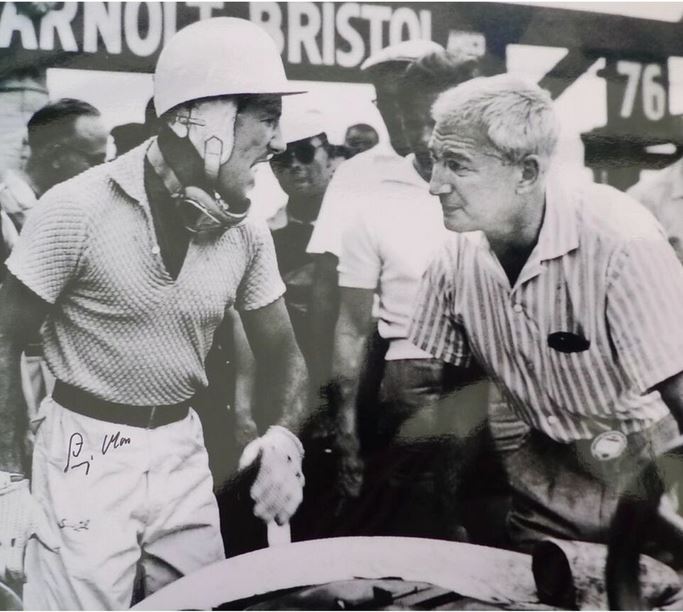
It wasn�t long before other racers approached the Argentinians about the useful clothing.  Fangio willingly gave Suixtil race pants away, and the logo began to appear in many podium pictures of the era as racers from different countries took the brand as their racing garb of choice.  The list of Suixtil racers includes Sir Stirling Moss, Benedicto Campos, Jose Froilan Gonzalez, Onofre Marimon, Roberto Mieres, Robert Manzon, Jean Behra, Jo Bonnier, Maurice Trintignant, Wolfgang Von Trips, Hans Herrmann, Paul Frere, Olivier Gendebien, Harry Schell, Karl Kling, Peter Collins, Andre Simon, and Pinhero Pires.


(Photo above:  Kling, Fangio, Moss - Sweden 55 - (c) Corsa research. Courtesy of Suixtil).


(Photo above: Sebring 1957 Moss, Duntov autographed by SM; courtesy of Suixtil).


(Photo above:  Monaco 1958 - Moss, Bonnier, Brooks, & Trintignant. Courtesy of Suixtil).


(Photo above:  Moss, Kling, Fangio, GP Sweden 1956, R Bruzelius. Courtesy of Suixtil).


(Photo above: Le Mans 1958 - Hawthorn, Behra, Von Trips, Moss. Courtesy of Suixtil).

The company disbanded when its founder died in the mid-1960s; however, it has come back to life recently under the efforts of Metais, to offer vintage-inspired clothing to motor racing enthusiasts and others who appreciate the history and look of the 1950s to early 60s era. Attention is paid to details in the products offered that honor the storied heritage of the brand and its close connection to motor racing in its early days.

When Formula 1 looks back at its 65-year history this weekend, it is interesting to consider that history in context with other aspects of racing at the time. It was the time of the first clothing designed specifically for racing, for one example, and the Suixtil Company holds the distinction of dressing some of the first racers in Formula 1. 

Proud of its heritage, Suixtil shares an enthusiasm for the early days of racing and its common history with the sport. A line on its website offering vintage clothing, accessories, and travel items to discriminating historic/vintage racing enthusiasts and others seems to offer current advice in vintage language, �While exerting oneself, style should not be forgotten or omitted.� 

The tradition of speed and style continues to this day with several Formula One drivers posing as models for clothing companies, luxury watch companies, etc.

The 2015 British Grand Prix (Sunday, July 5, 2015) will air live in the U.S. on CNBC starting at 7:30 a.m. Eastern and will re-air at noon on NBCSN.  For more information about Suixtil's history or its products, see the company's website.

Happy Birthday, Formula 1!


(Photo above: Trintingnant - 1961 - Watkins Glen - (c) BARC Boys-com. Courtesy of Suixtil).


(Photo above: Mt Ventoux 1958 - Behra, Barth, About, Von Trips, von Haustein. Courtesy of Suixtil).

Jumat, 27 Maret 2015

Formula One: 2015 Malaysian Grand Prix TV Schedule


Looking for the 2015 Formula 1 Malaysian Grand Prix TV and streaming schedule?  I've put it up on my National Formula One page at Examiner.com. 

Find that HERE.

Enjoy the race!


Senin, 23 Maret 2015

Historics: Goodwood 73rd Members' Meeting -- Day 2 results, 1970s F1 demo, C Type Demo, more


The Goodwood Estate in West Sussex, England put on its 73rd Members' Meeting over the weekend, March 21 and 22, 2015. 

This historic motor racing meeting is somewhat like the famous Goodwood Revival with a couple of notable differences -- there is no period dress required and much fewer "extra" activities going on -- people are there primarily for the racing.  The other difference is that the period the cars can come from -- 1948 - 1966 is opened up, both for cars before 1948 and for after 1966!

Here's my article about the results for Day 2 of the 73rd Members' Meeting at Goodwood.

Here is my article about Day 1.


Rabu, 11 Maret 2015

Formula 1: 2015 Australian Grand Prix TV schedule

[Image source].

The 2015 FIA Formula One Australian Grand Prix is set to happen this Sunday, March 15, launching the new season of the sport.

Looking for a simple listing of the TV schedule in the States?  I've prepared one on my National Formula One Examiner page, here.

Enjoy the race!

Rabu, 11 Februari 2015

Actor Hugh Grant talks racing on "Live With Kelly & Michael"


Some fans of historic/vintage motor racing may know that actors are, just like people in any other profession, drawn to the sport.  Though perhaps not as well known around the racing scene as a McQueen, a Newman, or even a Dempsey, British actor Hugh Grant, 54, is one of the internationally known thespians of late to take his chances behind the wheel of a race car.

Wednesday morning, February 11, 2015, Grant was in New York to promote the U.S. release of his film, The Rewrite.  Grant has starred in such movies as Four Weddings and a Funeral (1994); Notting Hill (1999); and Bridget Jones's Diary (2001). 

On Wednesday, he appeared on the morning talk show, Live With Kelly & Michael, to talk about The Rewrite.  Before they got to that, though, Michael Strahan asked him about his hobby -- racing cars.

Strahan wanted to know how much racing Grant has done, how many races, and has he been successful.

"I had a lot of training," replied Grant.  "And then I finally plucked up my car and did my first little series of races in Sweden last year.  I came in last, second last, and miles, miles last."

Kelly Ripa commented that it was perhaps good that he was not so competitive in the races, since he has children, and he needs to stay safe for them and not crash.

"You would think that," Grant said, "but I still manage to crash quite badly."  He continued with his dead-pan humorous description, "It�s an extraordinary sport.  It�s basically half an hour of middle-aged men trying to kill each other."
 
Stahan asked how fast they go.
 
"Pretty fast, down the straight," Grant said. "About 170 miles an hour or something."  The show's hosts and the audience were impressed with the speed.
 
 He continued, describing a bit more what the experience feels like to him.
 
"And you�re so miserable while you�re doing it," he said.  "You�re strapped in; everything hurts.  Sweat is pouring off of you.  You�re thinking, �Why am I doing this?  He�s trying to kill me.�  And then you get out at the end and feel kind of manly.  It�s very strange."
 
A funny way to describe racing -- but how true is it, and how many male racers do you know who admit to the discomfort in the car, as well as to their "manly" feelings afterwards?  Ha!  Maybe it takes a "charming" comedic actor, known for his roles in romantic comedies, to give spectators the real scoop about racing?  (or maybe he hasn't raced enough yet to find out the other pleasures of the sport?!).

Feel free to add your thoughts in the Comment section below!
 
Here is a link on YouTube to the interview.

Have fun on the track, Hugh -- maybe we'll see you around!

[Also fun to hear that Grant's movie The Rewrite is set at my college alma mater -- even in the English Dept. of -- Binghamton University!  Hope I can find a way to see the movie sometime!].


Senin, 02 Februari 2015

Destiny Racing USA, 2015 Schedule

Bulletin Board post:

Destiny Racing USA sends their schedule for 2015.  Posting it below for interested racers or especially for people on a budget who might be thinking about getting into historic/vintage racing for the first time, or who just want to try it with a low commitment, just to see what it's all about.

Tom Fitzgerald is the owner of his family business, Destiny Racing USA.  Tom is a friendly mechanic, owner/racer, and instructor from the Watkins Glen area.  He has cars for rent and track-side support at some of the most well-known tracks in the USA (see schedule below) where you can race them. (Note: if you are new to the sport, you will likely need racing lessons and certain other qualifications in order to join the competition events on the track). 

If you are a novice, my guess is that Tom will make you feel comfortable, not pressured.  If you have raced before, if you are an owner/racer, etc. but your cars are elsewhere and you don't want to take on the expense of hauling them to an event, he has some cars available to choose from that you might rent and race instead. 

Tom's company has headquarters in the Watkins Glen region (Geneva, NY) as well as at Sebring in Florida, so his racing season goes year-round.  See the schedules below for his contact information and events his company could help you participate in this racing season.  Enjoy!


Rabu, 03 Desember 2014

FIA announces 2015 Formula One race schedule


[Photo:  FIA.com].


The F�d�ration Internationale de l'Automobile (FIA) World Motor Sport Council (WMSC) met on Wednesday, December 3 ahead of the Prize-Giving Ceremony coming up on Friday in Doha, Qatar. Several decisions were made in the council meeting.

Among the announcements coming out of the meeting was the 2015 FIA Formula One World Championship schedule!

The eagerly awaited new race schedule for 2015 was confirmed by the FIA as follows:

  • March 15 -- Grand Prix of Australia

�         March 29 -- Grand Prix of Malaysia

�         April 12 -- Grand Prix of China

�         April 19 -- Grand Prix of Bahrain

�         May 3 -- Grand Prix of Korea (TBC) [still tentative, as of 12/3/14].

�         May 24 -- Grand Prix of Monaco

�         June 7 -- Grand Prix of Canada

�         June 21 -- Grand Prix of Austria

�         July 5 -- Grand Prix of Great Britain

�         July 19 -- Grand Prix of Germany

�         July 26 -- Grand Prix of Hungary

�         August 23 -- Grand Prix of Belgium

�         September 6 -- Grand Prix of Italy

�         September 20 -- Grand Prix of Singapore

�         September 27 -- Grand Prix of Japan

�         October 11 -- Grand Prix of Russia (Sochi)

�         October 25 -- Grand Prix of USA (Austin)

�         November 1 -- Grand Prix of Mexico

�         November 15 -- Grand Prix of Brazil

�         November 29 -- Grand Prix of Abu Dhabi

 
For more information about the meeting and decisions announced from it, see my Examiner F1 article here.

Formula One.com has a convenient, clear, and printable schedule HERE.  [Note:  As of 12/3/14, the printable schedule on Formula1.com does NOT include the Korea race].


Sabtu, 01 November 2014

Formula 1: COTA is Thatta Way -- Sunrise in Austin, Texas


[Photo credit:  Connie Ann Kirk].

Lots of sunrise pictures posted by Formula One teams and photographers this week.  That's because that's exactly what you see on your way to the track early in the morning!

This is my view just out my hotel room window, taken yesterday!

The Circuit of the Americas (COTA) racetrack is straight down the road in that direction. 

Good morning, race fans, from sunny Texas!

Jumat, 31 Oktober 2014

Formula 1: 2014 U.S. Grand Prix TV Schedule


[Photo Credit:  Connie Ann Kirk]

So, the Formula 1 road show is in town in the United States over Halloween weekend.  If Austin likes to "keep it weird," that might be a good recipe for doing so!  For those not venturing into the weirdness but staying home to feed trick-or-treaters maybe instead, here's the TV schedule for the 2014 Formula One United States Grand Prix.

TV schedule for the Formula 1 U.S. Grand Prix:

Friday, October 31 (Halloween):

*3 p.m. - 4:30 p.m.: Practice -- NBCSN -- LIVE
4:30 p.m. - 5 p.m.: "F1 Extra" -- NBCSN
10:30 p.m. - 12 midnight: Practice -- NBCSN -- Rebroadcast

Saturday, November 1:

*1 p.m. - 3:30 p.m.: Qualifying -- NBC -- LIVE

Sunday, November 2:

2:30 - 3 p.m.: Pre-Race -- NBC
*3 p.m. - 5 p.m.: United States Grand Prix RACE -- NBC -- LIVE
5 p.m. - 6 p.m.: Post-Race -- NBC

Enjoy!

Rabu, 29 Oktober 2014

Historics: Watkins Glen Racing Library talk to feature USRRC series, Nov. 8


[Photo:  Mark Donohue scrambles from his burning Lola T70 as Mak Kronn squeezes by in his McKee Mk6 during the Watkins Glen round of the United States Road Racing Championship on June 26, 1966. Donohue was not badly injured, but his Lola was a total loss. (photo by David Baker from the International Motor Racing Research Center�s Argetsinger Collection)].

The International Motor Racing Research Center in Watkins Glen, N.Y. / U.S.A. sends this press release today [provided in full below]:

"The USRRC lasted just six seasons, but its impact on racing was enormous, and now the series' history is reported in detail for the first time in USRRC: A record of the United States Road Racing Championship 1963-1968 by Mike Martin.

Martin of Seattle, Wash., will speak about the series and its crucial role in the development of professional road racing in America at the International Motor Racing Research Center in Watkins Glen on Nov. 8. The Center Conversations talk is free and open to all.

The USRRC was the Sports Car Club of America�s first series for professional race drivers.

'Without the USRRC, there could not have been a Can-Am, the better known and fully international series for the same type of car,' said award-winning motorsports author Michael Argetsinger. 'The Group 7 category, remembered today as Can-Am, pitted American engineering with the best from Europe and produced some of the most exciting race cars ever built. None of it would have evolved without the USRRC.

'The series, featuring unlimited displacement, two-seat sports cars, brought raw horsepower and speed that captured the imagination of fans, drivers and entrants alike. Scarabs, Porsche RS-61s and King Cobras dominated early years to be supplanted by iconic Chaparrals, Lola T70s and McLarens before the USRRC gave way to the Can-Am which would carry the tradition of unlimited race cars into the mid-�70s,' said Argetsinger, who is a member of the Center�s Governing Council.

John Bishop, SCCA executive director at the time, and his director of professional racing Jim Kaser were the key figures in the series� creation.

Bishop was instrumental in the founding of the Racing Research Center.

A review in Veloce Today describes Martin�s recently published undertaking as �an enthusiastic book which documents that exciting, noisy, time, in a way reflecting the social changes that were taking place in the nation, while proving that American know-how and muscle would finally prevail, at least on the race track.�

Offering a foreword by 1965 USRRC champion George Follmer, the book has more than 400 photographs, including some by Racing Research Center historian Bill Green.

Though he didn�t see a race until an event at Pacific Raceways in Kent, Wash., when he was 16, Martin was a race fan long before that. Collecting information about racing and writing about racing came naturally. Still a teenager, Martin wrote his first 'book' about racing � a 176-page history of the 1.5 liter Formula One years.

'I didn't think to try to get it published,' Martin says. 'However, years later I discovered The Formula One Record Book by the Formula One Register guys and realized there must be a market for this sort of thing. A seed was planted.'

Over the years Martin had his eye on a history of Formula Two racing, while helping other authors with their research. He switched gears in the 1990s to USRRC and dedicated 20 years to the project.

When not enjoying the world of racing or researching or writing about racing, Martin has had careers in banking, inventory control and electronics manufacturing.

Martin�s talk is part of the ongoing Center Conversations series.

The final talk of 2014 will be on Dec. 13 on the Carrera Panamericana. Tom Overbaugh and Paul Wendt will speak about the revival of the famous Mexican race that today takes both experienced racers and novices 2,000 miles across that nation in a week.

The Racing Research Center is an archival library dedicated to the preservation of the history of motorsports, of all series and all venues, through its collections of books, periodicals, films, photographs, fine art and other materials.

For more information about the Center�s work and its programs, visit www.racingarchives.org or call (607) 535-9044."


All of the Conversation series talks are free and open to the public.  They are always informative and held in a casual atmosphere with friendly people!

Jumat, 24 Oktober 2014

Historics: Goodwood 73rd Members' Meeting to feature "High Airbox" Formula 1 cars, 1971 - 1976


[Image Source:  Goodwood].

The Goodwood Estate in West Sussex, England has announced that it will feature at its 73rd Members' Meeting in 2015 "High Airbox" historic Formula 1 cars that date from 1971 to 1976.

According to Goodwood, the 73rd Members' Meeting, scheduled for March 21-22, will bring more than 25 high airbox Formula 1 race cars dating from 1971 to 1976 to the renowned Goodwood circuit. 

Among these will be, according to Goodwood's site:  "...two ex-Niki Lauda Ferrari 312Ts and a 312B3, two Lotus 72s and a 76, a pair of Marches, McLarens, Tyrrells, a Shadow DN1 and some rarer machinery like the only Amon AF101 in existence, a Trojan T103-1 and such a thing as a (the?) Token RJ02."

Seeing these 70s-era cars at Goodwood will provide a very different experience for those in attendance than visitors to the Goodwood Revival have the chance to see.  At the Goodwood Revival, cars on display and in action must be from the period of 1948 to 1966.

For more information about the 73rd Members' Meeting, check out the Goodwood website.


Formula 1: Red Bull's Daniel Ricciardo, Sebastian Vettel look ahead to U.S. Grand Prix, 2014


[Image Sources:  Daniel Ricciardo and Sebastian Vettel].

Red Bull drivers in Formula 1 are looking forward to the upcoming United States Grand Prix in Austin, Texas.  The race takes place at the Circuit of the Americas racetrack, a track purpose-built to bring Formula 1 back to the U.S. and one that has so far only hosted two previous Grands Prix.

About his return, now as a member of Red Bull and not Toro Rosso, Daniel Ricciardo said in a promotional release from Infiniti-Red Bull Racing:

"Hand on heart, this is probably the date on the calendar I look forward to the most. I�ve loved every minute of being in Austin: when they picked this place for the US Grand Prix, they absolutely nailed it. The city is awesome. I love listening to live music and this is a great place for that, plus Texas feels like real America, and that�s something I�ve really enjoyed just sinking into the last two seasons. And then, there�s the important bit. The Circuit of the Americas, in my opinion, is the best of the new breed of circuits. The nature of the corners is interesting. It�s also a very busy track where you don�t get much respite. The first sector is very special and that first turn, blind up the big hill is like nothing else in F1. It�s also a good example of the excitement a late-apex can create: you can have a really good lunge there. They�ve done a very good job."


In the same release, four-time World Champion Sebastian Vettel had this to say about the venue:

"Austin is a fun city where you get a real feel for the Texan lifestyle and traditions and get to race on a great track. The Circuit of the Americas is a track I like a lot; it has 20 corners and we drive it anti-clockwise. The start/finish straight has a steep incline up to the first corner and is the trademark of the track. For us that means the braking starts uphill, which is not easy and locking the front tyres could be a problem. A lot of the corner combinations remind me of other famous circuits on the race calendar. For example the fast combination during the first part of the track feels like Silverstone and Suzuka. The famous Maggotts and Becketts passages were used as a model for this part of the track and the drivers enjoy the extremely fast turns, when the car is balanced right. Also corners 12 and 15, this section was taken from the Motodrom in Hockenheim. It is a slower part of the track, and is designed to create more of a stadium atmosphere. The long bend also reminds of the famous turn 8 in Istanbul."

The 2014 U.S. Grand Prix takes place over Halloween weekend in the States, October 31-November 2. 

It has not yet been announced whether reserve driver, American Alexander Rossi, will race for Marussia's injured driver, Jules Bianchi, who remains hospitalized following a head injury suffered in a crash at the Japanese Grand Prix.


Rabu, 22 Oktober 2014

Another pilgrim seeks out Francois Cevert sites at Watkins Glen


[Book cover photo: L'Autodrome.].

I was sent this link to a blog post by Philippe Robert, who made a pilgrimage in 2014 to Watkins Glen, New York / USA in tribute to Formula 1 racer, Francois Cevert.

Glad to pass along the link that tells about Mr. Robert's journey to the Glen.  The post is, however, in French.

LINK:  http://classiccourses.hautetfort.com/archive/2014/10/05/greetings-from-watkins-glen-5462130.html


[Key photo:  L'Autodrome].

The key above was Francois's room key from the Glen Motor Inn, where many drivers stayed in the 1960s and 70s during the Formula 1 United States Grand Prix every October.  The key was found in Francois's briefcase after he died on the track at Watkins Glen on October 6, 1973.  The photo comes from the book about Cevert co-written by the driver's sister and pictured at the top of this post. 

It is haunting to see the room key for Room #7, thought to be a lucky number by some.  The Glen Motor Inn, overlooking scenic Seneca Lake, still exists and remains in operation to this day, mostly unchanged from the Grand Prix days.  As Mr. Robert writes in his blog post, he was able to stay the night in Cevert's very room. 

The Cevert book was initially printed in a limited edition in 2013 to mark the 40th year of Cevert's passing. 

There is a wish among some fans that the book be translated into English.

BOOK:  Francois Cevert:  Legendary Driver by Jacqueline Cevert-Beltoise and Johnny Rives. 

 Sir Jackie Stewart and Jean-Claude Killy.
 L'Autodrome

The book is available to read on the premises at the International Motor Racing Research Center in Watkins Glen.  As with all the rare books in the reference library at the IMRRC, it may not be checked out. 

Thank you, Philippe Robert, for sharing your experience with readers.

In sending me his blog link, Mr. Robert referred to reading my own blog story about Francois Cevert and Watkins Glen as one of the factors in his deciding to make the trip from France to the Glen.  You can read my Motor Sport Muse post about looking for signs of Cevert's crash at the Glen on the 40th anniversary of his passing, HERE.

RIP, Francois Cevert.